> ## Documentation Index
> Fetch the complete documentation index at: https://docs.acusight.io/llms.txt
> Use this file to discover all available pages before exploring further.
# Edge data collection
> How AcuSight collects image data from edge devices in real time — and turns it into a project you can label.
Everything starts with data. This guide shows how AcuSight collects images from your edge devices in real time, keeps that data diverse, and hands it off to a project — the first step toward training a model.
## How collection works
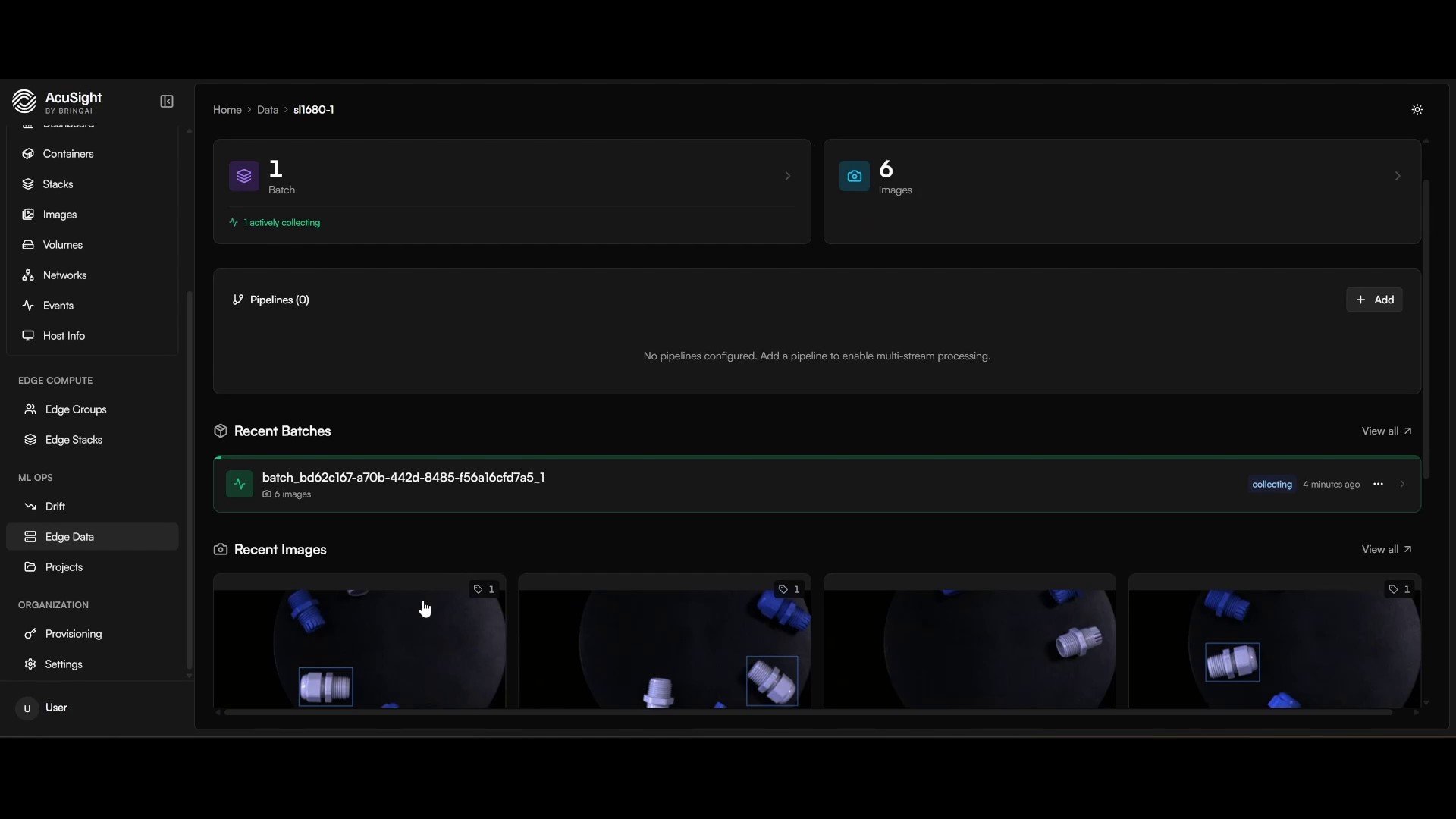
Once a device is [provisioned](/guides/deploy/device-provisioning), it captures images and streams them to AcuSight continuously — no manual upload, no copying files off an SD card. New images arrive on their own: they show up under the device's **Edge Data**, and the device appears on **Home** with live status.
 ## Batches
Incoming images are grouped automatically into **batches**. A batch stays **collecting** as images arrive, then **auto-completes** once it's full or the device goes quiet — no manual bookkeeping. Each completed batch is a tidy unit of data you can move into a project.
## Keeping your data diverse
A model only learns from variety. Hundreds of near-identical frames of the same still object teach it very little — and can quietly bias it toward one view.
To prevent that, AcuSight filters images **as they're ingested**: it measures the difference between incoming frames and automatically drops ones that are too similar — where little has changed since the last. It happens on its own, with nothing to configure, so each batch stays visually diverse and representative of what the device actually sees. The result is a smaller, richer dataset that trains a better model.
Diversity beats volume. A few hundred varied images — different angles, lighting, and parts — will outperform thousands of copies of the same shot.
## Move it into a project
Collected data waits in the raw pool until you put it to work. When you're ready:
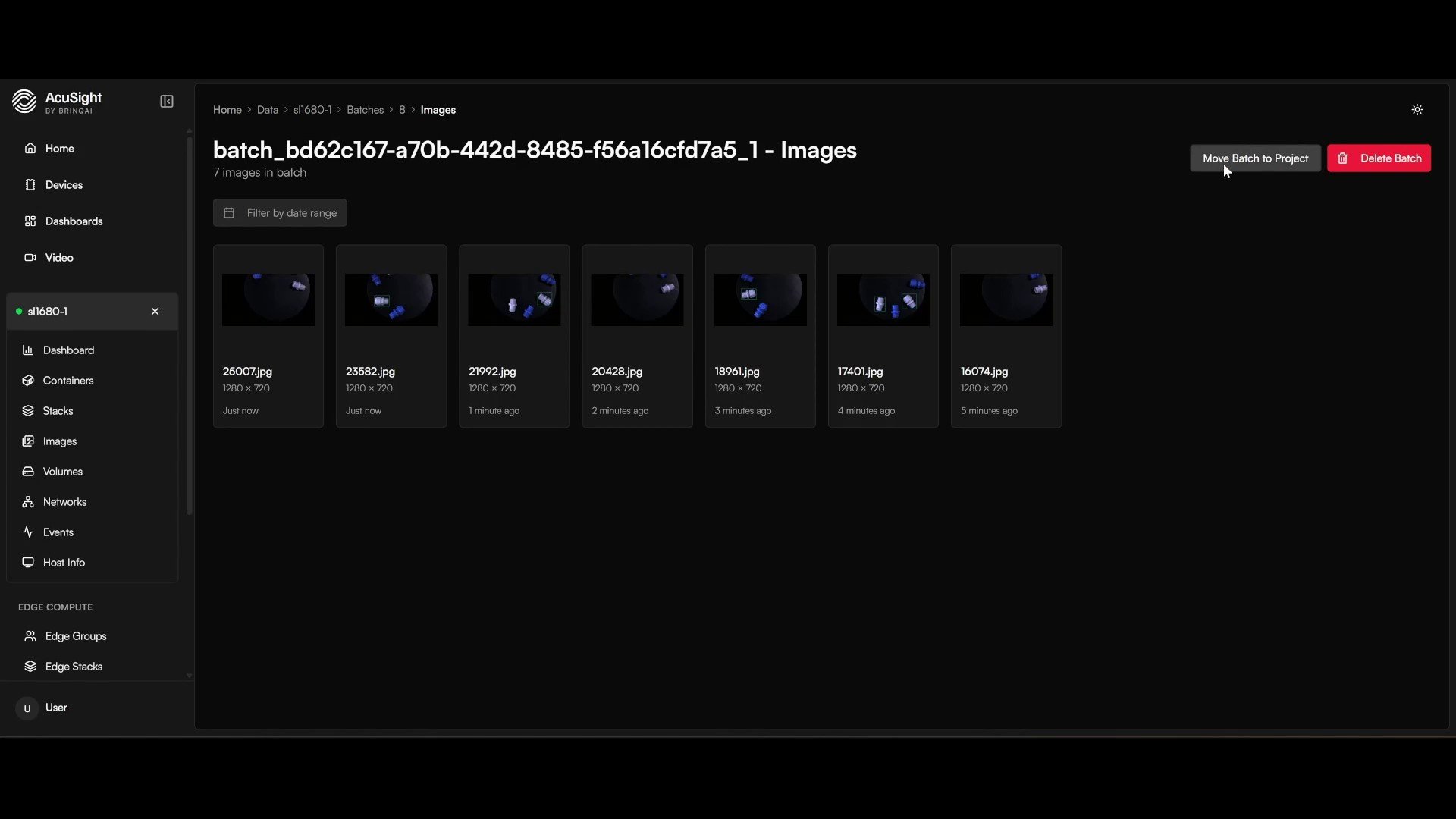
1. Open the batch under **Data**.
2. Select **Move Batch to Project** and choose your project.
The batch lands in your project's **Annotate** board, ready to label.
## Batches
Incoming images are grouped automatically into **batches**. A batch stays **collecting** as images arrive, then **auto-completes** once it's full or the device goes quiet — no manual bookkeeping. Each completed batch is a tidy unit of data you can move into a project.
## Keeping your data diverse
A model only learns from variety. Hundreds of near-identical frames of the same still object teach it very little — and can quietly bias it toward one view.
To prevent that, AcuSight filters images **as they're ingested**: it measures the difference between incoming frames and automatically drops ones that are too similar — where little has changed since the last. It happens on its own, with nothing to configure, so each batch stays visually diverse and representative of what the device actually sees. The result is a smaller, richer dataset that trains a better model.
Diversity beats volume. A few hundred varied images — different angles, lighting, and parts — will outperform thousands of copies of the same shot.
## Move it into a project
Collected data waits in the raw pool until you put it to work. When you're ready:
1. Open the batch under **Data**.
2. Select **Move Batch to Project** and choose your project.
The batch lands in your project's **Annotate** board, ready to label.
 Don't have a project yet? Create one first — see [Projects & batches](/guides/data/projects-batches).
## Next step
Organize your data into projects and see how batches move through the workflow.
Don't have a project yet? Create one first — see [Projects & batches](/guides/data/projects-batches).
## Next step
Organize your data into projects and see how batches move through the workflow.